
When you’re stuck in the belief that “my partner never listens to me”, conversations feel pointless and frustrating. You share something important, and they’re distracted, dismissive, or tuned out completely.
This article explains why your partner never listens, what’s really happening beneath the surface, and practical steps to fix the pattern.
You’ll learn how to communicate in ways that get through, when the problem signals deeper issues, and how professional support helps couples rebuild genuine connection.
It does hurt when it feels like you aren’t being heard
You tell them about your day, a problem at work, or something that matters to you, but the response you get may be frustrating. They nod while scrolling their phone or interrupt before you finish.
It feels dismissive, like what you say doesn’t matter. Over time, you stop sharing altogether because what’s the point if nobody’s really listening?
When your partner never listens, it chips away at emotional connection and you start feeling invisible in your own relationship.
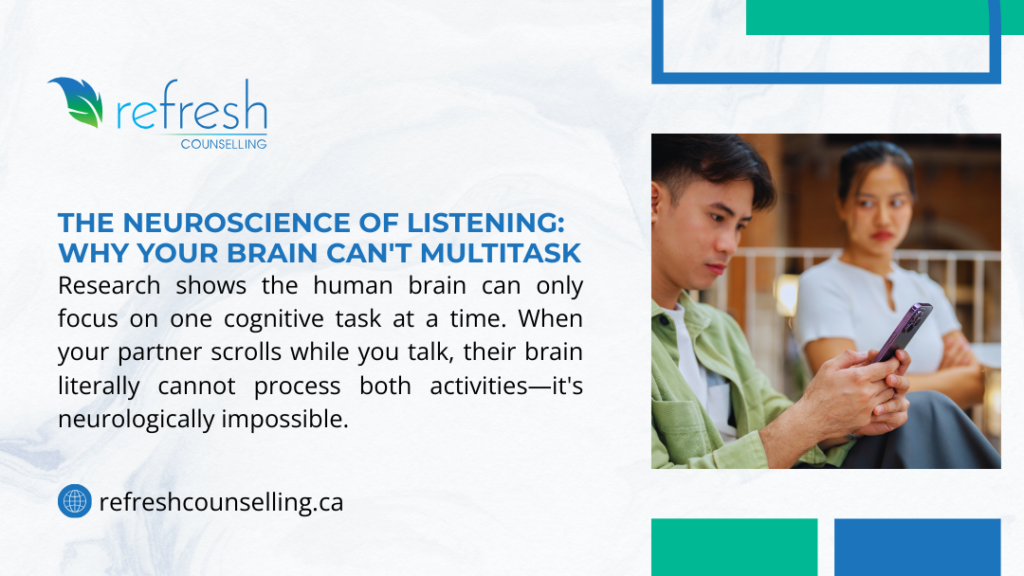
How to Identify When Your Partner Isn’t Truly Listening
Many people search for answers because they keep thinking, “My partner never listens to me, what am I doing wrong?”
Many couples argue about whether someone was really listening. Recognizing specific behaviors helps you identify the actual problem instead of just feeling frustrated.
- Physically Present But Mentally Absent
Your partner sits right next to you while you talk. Their body is there, but their mind is somewhere else entirely.
| Behavior | What It Looks Like |
| Distracted listening | Stares at phone, TV, or computer while you talk |
| Surface acknowledgment | Offers minimal acknowledgment without meaningful engagement |
| Forgetting immediately | Can’t recall conversation five minutes later |
| Physical presence only | He is in the same room but completely checked out |
- Interrupts or Changes the Subject
You start sharing something and your partner never listens past the first sentence before jumping in. They interrupt with their own story or shift topics completely.
This pattern tells you they’re waiting to talk, not actually listening to understand what you’re saying. Their focus stays on their own thoughts rather than your experience.
- Get Defensive Instead of Hearing You Out
The moment you bring up concerns or feelings, they react defensively. They argue, make excuses, or turn things back on you.
This defensive response blocks real listening. If your partner gets so defensive every time you try to communicate, the pattern prevents any meaningful conversation from happening.
- Dismisses Your Feelings
When you express emotions, they minimize or brush them off. They say things like “you’re overreacting” or “it’s not that big of a deal.”
Dismissing feelings is a specific form of not listening. It tells you their judgment about your emotions matters more than what you’re actually experiencing.
Why Your Partner Never Listens: The Real Reasons
Understanding what blocks listening helps you address the actual problem instead of just feeling hurt and frustrated about it.
- They’re Genuinely Overwhelmed
Sometimes a partner never listens because they’re mentally maxed out. Work stress, health worries, or family problems consume all their mental energy.
They’re not choosing to tune you out. Their brain literally can’t process one more thing right now.
| Root Cause | What’s Happening | Impact on Listening |
| Stress overload | Brain is already processing too much | Can’t focus on conversations |
| Mental exhaustion | No energy left for active listening | Zones out without meaning to |
| Emotional burnout | Shut down to cope with overwhelm | Goes through motions of listening |
| Crisis mode | Survival brain takes over | Only hears surface-level information |
- Poor Listening Skills From Childhood
Many people never learned how to listen properly. Their parents didn’t model active listening, or they grew up in environments where everyone talked over each other.
If your partner never listens well, they might genuinely not know how. This isn’t an excuse, but it explains why the pattern persists.
- They Feel Criticized or Attacked
When someone expects criticism, they stop listening and start defending. Your partner might hear an attack in your tone even when you’re just trying to talk.
This creates a cycle where you feel unheard, so you get more frustrated, which makes them more defensive. The pattern feeds itself until nobody’s really listening to anyone.
- The Topic Makes Them Uncomfortable
Some conversations trigger anxiety, guilt, or other uncomfortable emotions. When your partner never listens during specific discussions, emotional discomfort might be blocking their ability to engage.
They check out mentally as a protection mechanism. It’s not conscious or intentional most of the time.
- Emotional Unavailability
Sometimes a partner never listens because they’re emotionally unavailable in the relationship overall. Poor listening is just one symptom of a broader pattern where they struggle to connect emotionally.
This goes deeper than distraction or poor skills. It reflects difficulty with vulnerability and emotional intimacy that affects the entire relationship.
7 Psychological Ways to Get Your Partner to Actually Listen
- Start with Timing, Not Content
Choose moments when your partner can actually focus. Trying to have important conversations when they’re stressed, distracted, or exhausted sets you up for frustration.
Ask “Is now a good time to talk about something?” before diving into meaningful topics. This simple question dramatically improves how well your partner listens because they’re mentally prepared to engage.
| Strategy | How to Use It | Why It Works |
| Check availability | “Can we talk for 10 minutes?” | Prepares them mentally to listen |
| Avoid crisis timing | Don’t bring up big issues when stressed | Stress blocks listening ability |
| Schedule important talks | “Can we talk about this after dinner?” | Gives time to shift mental focus |
| Keep it brief first | Start with short conversations | Builds listening stamina gradually |
- State What You Need Clearly
Your partner can’t read your mind. When you need them to really listen, say that explicitly.
Try: “I need you to just listen right now, not fix anything.” Or: “Can you put your phone down? This is important to me.”
Clear requests work better than hoping they’ll figure out what you need on their own.
- Use “I” Statements Instead of “You” Accusations
When your partner never listens, it’s tempting to say “You never pay attention to anything I say!” This triggers defensiveness immediately.
Switch to: “I feel unheard when conversations get interrupted.” This focuses on your experience rather than attacking their character.
Studies from the Journal of Marriage and Family show that using “I” statements reduces defensive responses and increases productive conversation in couples by nearly 60%.
- Make Eye Contact and Minimize Distractions
Model the listening behavior you want from them. Put your own phone away, turn off the TV, and create space for actual conversation.
When both people focus fully, listening improves on both sides. Your attention signals that the conversation matters, which encourages them to match that energy.
- Appreciate When They Do Listen Well
When your partner actually listens well, acknowledge it. A simple “thank you for really hearing me just now” reinforces the behavior you want more of.
People repeat behaviors that get positive recognition. Catch them doing it right instead of only pointing out when they fail.
- Address Patterns, Not Individual Moments
One conversation where your partner never listens properly might just be a bad day. If it happens repeatedly for weeks or months, address the pattern itself.
Say: “I’ve noticed that when I try to talk about [topic], you seem checked out. Can we talk about what’s happening there?”
| Approach | Example | Result |
| Attack character | “You’re a terrible listener” | Defensiveness, shutdown |
| Criticize behavior | “You never listen to me” | Argument about whether that’s true |
| Notice pattern | “I’ve felt unheard during our last few conversations” | Opens discussion about what’s wrong |
| Express impact | “When conversations get cut off, I feel disconnected” | Helps them understand real effects |
- Get Professional Support When Needed
Sometimes a partner never listens because deeper issues block connection. Couples counseling provides neutral space to work through communication patterns that feel stuck.
At Refresh Counselling, we help Calgary couples rebuild listening and communication skills that create genuine connection. Our therapists identify what’s blocking good listening and teach practical techniques both partners can use immediately.
When Poor Listening Signals Bigger Problems
Not all listening issues are simple communication problems. Sometimes when your partner never listens, it points to relationship patterns that need more serious attention.
Complete Emotional Shutdown
If your partner won’t engage in any meaningful conversation for months, refuses to discuss the relationship at all, or actively avoids all emotional topics, the listening problem might reflect deeper emotional unavailability or relationship disconnection.
Contempt and Disrespect
When your partner never listens and adds eye-rolling, sarcasm, or obvious disrespect, the Gottman Institute identifies this as one of the “four horsemen” that predict relationship failure. Contempt is more serious than simple distraction.
Zero Effort to Improve
You’ve explained how the pattern hurts you multiple times. Your partner acknowledges the problem but makes zero effort to change anything.
When someone won’t even try to listen better after you’ve clearly expressed how much it matters, that signals a lack of investment in the relationship.
The Pattern Affects Everything
Poor listening spills over into every aspect of your relationship. They don’t hear about your day, your needs, your feelings, or your concerns about the relationship itself.
This level of consistent disconnection requires professional support to address properly.
Moving Forward: Rebuilding Communication That Works
When your partner never listens, it damages the foundation of your relationship. Good communication doesn’t mean perfect agreement—it means both people feel heard and valued even during disagreements.
Most listening problems improve with awareness and practice. When both partners commit to the work, couples see significant changes in how connected and understood they feel within just a few months.
If you’ve tried improving communication on your own without progress, professional support makes a real difference. Couples counseling helps you break patterns that feel impossible to shift alone.
Next steps:
- Choose one strategy from this article to try this week
- Have a calm conversation with your partner about feeling unheard
- Notice your own listening habits and what blocks your ability to hear them
- Reach out for professional support if the pattern persists despite your efforts
The goal isn’t perfect listening every moment. It’s creating a relationship where both people feel heard, valued, and connected most of the time.
Frequently Asked Questions About “My Partner Never Listens to Me”
Why does my partner never listen when I talk about my feelings?
Emotional conversations make many people uncomfortable, especially if they didn’t grow up in homes where feelings were discussed openly. Your partner might shut down during emotional topics because they don’t know how to respond or feel overwhelmed by the intensity.
Can a relationship survive if one partner never listens?
Long-term, no. Feeling consistently unheard creates resentment, disconnection, and loneliness that erodes relationship satisfaction over time. However, if both partners recognize the problem and work to change it, listening patterns can improve significantly.
How long does it take to fix communication problems in a relationship?
With consistent effort and possibly couples counseling support, most couples see noticeable improvements in communication within 8-12 weeks. Deeper patterns might take several months to fully shift, but changes start happening relatively quickly when both people commit to the work.