
How Can Music Therapy Support Autistic Children?
If you’re the parent of an autistic child, you may already have a lot on your plate.
There may be school meetings, appointments, assessments, different supports to consider, and plenty of opinions about what your child “needs.”
So when someone suggests another approach, it’s understandable to wonder: What exactly is this, and how could it help my child?
Music Therapy can provide autistic children with another way to communicate, connect, express themselves, and work toward goals that are meaningful to them.
Importantly, the goal isn’t to change who your child is.
Instead, Music Therapy starts with the individual child—their strengths, interests, preferences, ways of communicating, and the areas where they may benefit from additional support.
1. What Is Music Therapy for Autistic Children?
Music Therapy uses music intentionally to support therapeutic goals.
A Music Therapist might use instruments, songs, rhythm, movement, listening, or simply making music together as part of a session.
But the goal isn’t to teach your child how to become a musician.
Music is the tool, not the end goal.
For one child, the goal might be finding new ways to communicate. For another, it might involve expressing emotions, building confidence, connecting with another person, or developing strategies for managing big feelings.
Sessions are built around the individual child rather than expecting the child to fit into a predetermined program.
And your child doesn’t need any musical experience to participate.
2. Why Music?
Music gives us many ways to communicate.
We can use words, but we can also use sound, rhythm, movement, volume, tempo, and even silence.
That can make music particularly useful for children who don’t always communicate what they’re experiencing through conversation alone.
Another Way to Express Yourself
Some autistic children communicate differently or may find certain conversations difficult.
Music can provide another option.
A child might tap a rhythm, choose a song, play an instrument, move to music, sing, make sounds, or simply listen.
The therapist can meet the child there rather than requiring communication to happen in one particular way.
Structure With Room for Choice
Music can also be predictable.
Songs have patterns. Rhythms repeat. Children can begin to anticipate what comes next.
At the same time, music leaves plenty of room for choice.
A child might decide which instrument to use, whether to play loudly or quietly, which song to hear, or how they want to participate.
Those choices matter.
Building on What a Child Already Enjoys
Some autistic children already have a strong connection with music.
Maybe your child repeatedly listens to a favourite soundtrack, hums songs throughout the day, taps rhythms on everything in sight, or has very specific musical interests.
A Music Therapist can use those existing interests as a natural place to begin connecting with the child.
3. What Can Music Therapy Support?
There isn’t one set of goals for autistic children in Music Therapy.
The goals should reflect the individual child and what would be helpful and meaningful in their everyday life.
| Area | What That Might Look Like |
| Communication | Using music, sounds, songs, words, or instruments as different ways to express wants, ideas, or feelings |
| Emotional Expression | Giving a child another way to express excitement, frustration, anxiety, sadness, or other feelings |
| Emotional Regulation | Using rhythm, familiar music, or changes in the pace and feel of music to help a child recognize and manage big feelings |
| Connection | Making music together, sharing an activity, taking turns, or responding to one another |
| Confidence & Choice | Giving the child opportunities to make decisions, lead activities, create, and participate in ways that feel successful |
| Individual Goals | Adapting activities around the child’s particular interests, strengths, needs, and comfort level |
The important point is that Music Therapy doesn’t look the same for every autistic child—because autistic children aren’t all the same.
4. What Does a Music Therapy Session Actually Look Like?
Parents sometimes picture a Music Therapy session as a child sitting at a piano learning songs.
It can look very different from that.
A session is flexible and designed around the individual child’s comfort level and goals.
It might include:
Instruments and Percussion
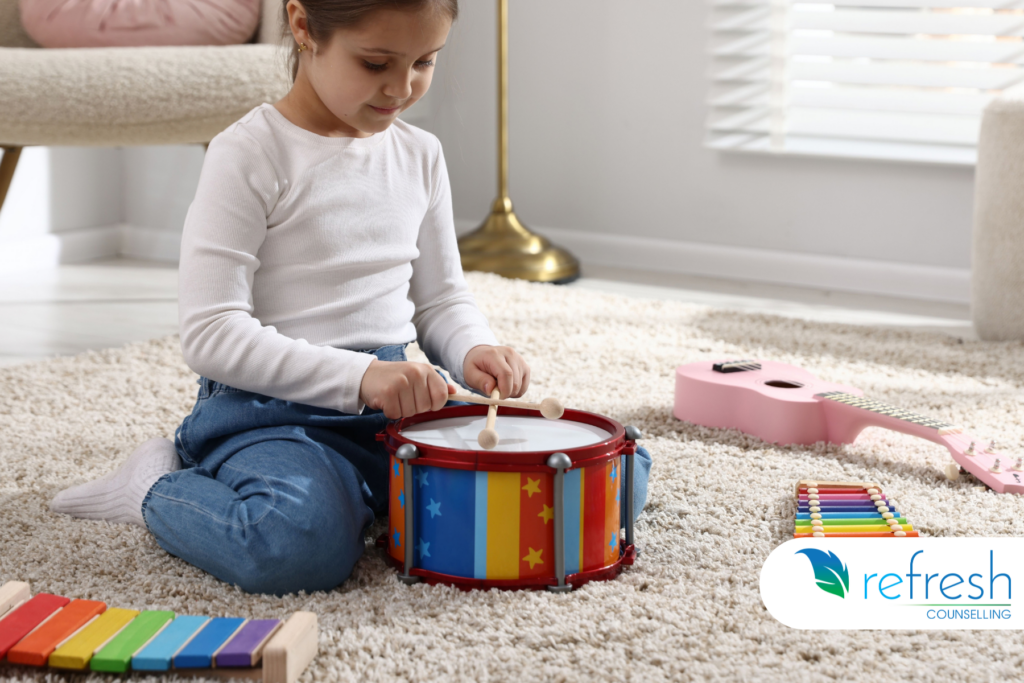
A child might explore drums, xylophones, guitars, keyboards, or other accessible instruments.
The goal isn’t to play perfectly. A therapist may simply follow what the child is doing and begin making music with them.
Child-Led Music Making
If a child starts tapping a pattern, the therapist might tap along.
That simple interaction can turn into a shared musical experience without requiring the therapist to interrupt it with questions or instructions.
Singing and Sounds
Some children may enjoy singing familiar songs. Others may prefer making sounds or experimenting with their voice.
Both can be meaningful ways to participate.
Favourite Music
A child’s favourite songs, soundtracks, artists, or styles of music can be incorporated into sessions.
Familiar music can make the environment feel more comfortable while also giving the therapist another way to connect with the child.
Making Music Together
The therapist and child might create their own rhythms, songs, or sounds together.
There doesn’t need to be a right or wrong way to do it.
Movement
For children who enjoy movement, music can be combined with dancing, actions, or other physical activities.
Songwriting
Older children may enjoy creating songs or changing existing lyrics to express their thoughts, interests, identity, or experiences.
One child’s session might involve energetic drumming and movement. Another child’s might involve quietly listening to favourite songs and playing a few sounds on an instrument.
Both can be Music Therapy.
5. Supporting Your Child — Not Changing Who They Are
This is an important distinction.
Music Therapy isn’t about curing autism or trying to make an autistic child behave more like a neurotypical child.
A supportive approach starts by getting to know the child in front of us.
What do they enjoy?
How do they communicate?
What makes them feel comfortable?
What situations are difficult for them?
Where might additional support make everyday life easier or more fulfilling?
A child who rocks, moves, hums, repeats sounds, or communicates differently shouldn’t automatically be taught to stop simply because their behaviour looks different.
Instead, the focus can be on goals such as helping the child feel understood, communicate what they need, express themselves, manage difficult emotions, build confidence, and connect with others in ways that feel comfortable for them.
The question becomes less about “How do we change this behaviour?” and more about “What is this child communicating, and how can we support them?”
6. How Does Music Therapy Fit With Other Autism Supports?
Music Therapy doesn’t need to exist on its own.
Depending on your child’s needs, it may be one part of a broader circle of support that could include school supports, counselling, a physician, an occupational therapist, a speech-language pathologist, or other professionals.
For example, a Music Therapist may use songs, rhythm, sounds, and musical interaction to support communication goals. Music and movement might also provide opportunities to work on coordination or other individualized goals.
Music Therapy can also offer children another way to explore emotions and express themselves alongside more traditional counselling or mental health supports.
There isn’t one combination that’s right for every autistic child.
The goal is to find supports that are genuinely helpful for your child, without filling their schedule with so many appointments that therapy itself becomes overwhelming.
Exploring Music Therapy for Your Child at Refresh Jr.
If your child naturally connects with music—or you’re looking for another way to support communication, emotional expression, regulation, confidence, or connection—Music Therapy may be worth exploring.
At Refresh Jr., Music Therapy is centred around the individual child. Their interests, strengths, preferences, comfort, and goals help shape what sessions look like.
Your child doesn’t need to know how to play an instrument. They don’t need to perform. And they don’t need to communicate in one particular way to participate.
Contact Refresh Counselling to learn more about Music Therapy at Refresh Jr. and whether it might be a good fit for your child.