
How Time Blocking Restores Mental Clarity and Calms Anxious Minds
In our modern, always-on world, it often feels like our brains are running fifty browser tabs simultaneously. We juggle professional demands, family commitments, household chores, and the silent pressure to maintain a social life and personal well-being. When every single task clamors for your immediate attention, your mind becomes a crowded, noisy place.
For individuals experiencing anxiety, this constant influx of demands isn’t just annoying—it’s exhausting. The feeling of being pulled in a dozen different directions at once erodes our mental clarity, leaving us feeling paralyzed, fatigued, and overwhelmed.
But what if the antidote to this chaotic mental clutter isn’t doing less, but rather organizing our time differently?
By using intentional organizational systems like time blocking, we can radically reduce our cognitive load, soothe an overactive nervous system, and reclaim a sense of spaciousness in our daily lives. Here is a deep dive into how time blocking can serve as a powerful tool for your mental health, and how you can implement it with self-compassion.
The Weight of the Unseen: How Anxiety Creates Mental Clutter
Anxiety is more than just a feeling of worry; it is a high-energy cognitive state that actively consumes your brain’s processing power. When you are anxious, your brain perceives a threat, shifting your nervous system into a state of hypervigilance. In daily life, this threat response translates into a chronic sense of urgency around your to-do list.
Every uncompleted task, unreplied email, or upcoming appointment becomes an invisible weight. Psychologists refer to this as the Zeigarnik Effect—the tendency of the human brain to remember uncompleted or interrupted tasks more vividly than completed ones. Your brain keeps spinning these incomplete loops in the background, desperately trying not to forget anything.
When your day lacks a clear structure, you are forced to engage in constant decision-making. Every hour presents a new dilemma: Should I work on that project now? Or should I fold the laundry? Wait, did I call the dentist back? This endless loop of micro-decisions drains your executive functioning capacity, leading to a phenomenon known as decision fatigue.
By the time the afternoon rolls around, your cognitive energy is entirely depleted, leaving you highly vulnerable to increased anxiety, irritability, and brain fog.
The Anatomy of Mental Overwhelm
| Anxious Mental State | Impact on Cognitive Energy | Resulting Experience |
|---|---|---|
| Hypervigilance | Constantly scanning for missed tasks or upcoming deadlines. | Chronic background stress and inability to relax. |
| Decision Fatigue | Wasting mental energy choosing what to do next, minute by minute. | Procrastination, paralysis, and low productivity. |
| The Zeigarnik Effect | Brain keeps “open loops” running for every unfinished task. | Severe mental clutter and reduced short-term memory capacity. |
| Uncertainty & Drift | Lacking a concrete plan for when work ends and rest begins. | Guilt during downtime; burnout during work hours. |

Reducing the Cognitive Load through Organizational Systems
To restore mental clarity, we must find a way to lower our cognitive load. The most effective way to do this is by outsourcing our memory and decision-making to an external, dependable system.
When we write things down and assign them a specific time and place, we effectively “download” the information out of our working memory. This frees up immense psychological bandwidth. An organized calendar acts as a secondary brain. It holds the details so your primary brain doesn’t have to.
This is where time blocking comes in. Time blocking is a time management method where you divide your day into distinct blocks of time. Each block is dedicated to accomplishing a specific task, or a specific group of tasks, and only those tasks. Instead of keeping an open-ended, intimidating to-do list, you assign your tasks a dedicated home on your calendar.
Making the Invisible Visible: Why Time Blocking Calms the Nervous System
Anxiety thrives on the abstract, the vague, and the infinite. An unanchored to-do list feels infinite because it has no boundaries. When you look at a list of twenty items, your brain naturally panics because it cannot visually conceptualize when or how all of those things will get done.
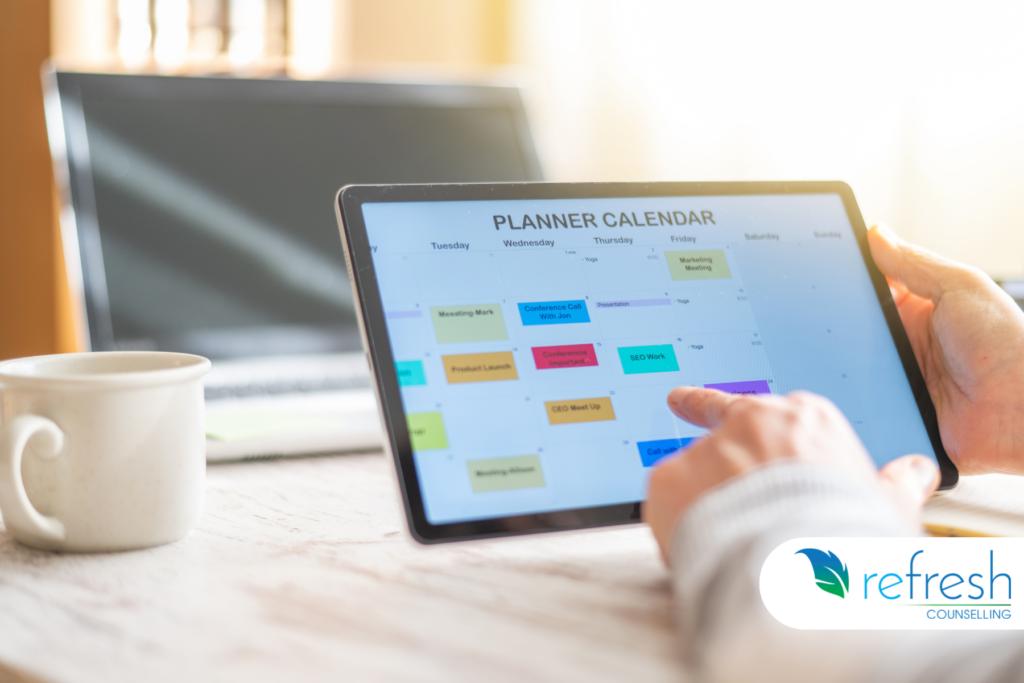
Time blocking reduces overwhelm by making the invisible visible. It forces you to confront the reality of time. A day only has 24 hours, and your working day likely only has seven or eight. When you map your tasks onto a physical calendar grid, you transform an abstract, overwhelming mountain of obligations into concrete, finite blocks of space.
This visual mapping does something profound for your nervous system:
- It provides containment: It tells your anxious brain, “We don’t need to worry about the grocery shopping right now, because it has a dedicated home at 4:00 PM.”
- It eliminates choice paralysis: When you step into a time block, the decision of what to do has already been made for you by your past, calm self.
- It validates your limits: It prevents you from over-committing because you can physically see when your day is full.
By creating external accountability through your calendar, you give your sympathetic nervous system (the “fight-or-flight” branch) permission to step down. The calendar takes over the role of the sentinel, allowing you to settle into a focused, calm state of deep flow.
Structure as a Support System, Not a Cage
For many individuals who struggle with perfectionism or anxiety, the idea of a strict schedule can initially feel restrictive, or even triggering. If you view a schedule as a rigid set of rules you must follow perfectly, any deviation can feel like a failure, sparking a secondary wave of anxiety.
To use time blocking successfully for mental health, you must shift your mindset: think of structure as support, not control.
Your calendar is not a prison warden punishing you for falling behind. Instead, try to view your time blocks as an aid, a gentle coach, or a deeply caring friend looking out for your well-being. A caring friend wouldn’t demand that you work non-stop for eight hours without a break. A caring friend would build in time for you to stretch, eat a nourishing lunch, step outside for fresh air, and breathe.
When you approach time blocking from a place of self-compassion, you realize that you do not need to be perfect. Life happens. Interruptions will occur. A child gets sick, a meeting runs over, or your energy simply dips. When a time block gets disrupted, it isn’t a failure—it’s just data. You simply slide the blocks around, adapt, and move forward. The goal is intentionality, not rigid perfection.
Shifting Your Mindset Around Time Structure
| Viewing Structure as Control (Anxious Mindset) | Viewing Structure as Support (Compassionate Mindset) |
|---|---|
| “I have to stick to this schedule perfectly or I’ve failed.” | “This schedule is a flexible blueprint to guide my day gently.” |
| “Every minute must be optimized for maximum productivity.” | “I am intentionally blocking out time for productivity, rest, and play.” |
| “If a meeting runs over, my whole day is ruined.” | “Life is dynamic. I will adjust my remaining blocks with kindness.” |
| “The calendar controls me; I am trapped by the clock.” | “I control the calendar; it is a tool I designed to protect my peace.” |
The Slippery Slope: Avoiding the Trap of Over-Scheduling
While time blocking is a fantastic tool for generating mental clarity, it is a slippery slope. For those with high-achieving or anxious tendencies, it is incredibly easy to accidentally weaponize this organizational system against yourself.
When you first experience the satisfaction of scheduling your day, you might be tempted to pack your calendar solid. You block out every single 15-minute interval from 6:00 AM to 10:00 PM, leaving absolutely no empty space.
This is a recipe for severe stress and burnout. Over-scheduling creates a hyper-rigid day where the slightest delay throws off the entire ecosystem, instantly spiking your cortisol levels. If your calendar looks like a crowded puzzle with zero breathing room, your organization system has become the very source of your anxiety.
To avoid this trap, practice protective time blocking:
- Buffer Blocks: Always leave 15 to 30 minutes of unassigned buffer time between major tasks. Use this time to stretch, make a tea, or simply catch your breath.
- Reactive Blocks: If your job involves a lot of incoming requests, emails, or emergencies, create a daily 1-hour “Reactive Block” dedicated entirely to handling the unexpected.
- White Space: Intentionally schedule blocks of completely open, unstructured time. Call it “Do Nothing Time” or “Spontaneous Space.” This gives your mind the freedom to wander, which is vital for creative thinking and emotional processing.
Step-by-Step: How to Build an Anxiety-Reducing Time Block Plan
If you are ready to experiment with time blocking to clear your mental clutter, use this gentle, step-by-step approach:
- The Brain Dump: Before looking at a calendar, write down everything running through your mind on a blank piece of paper. Get all the tasks, worries, and reminders out of your head.
- Identify Core Priorities: Pick 2 to 3 essential tasks that genuinely need your focus today. Let go of the expectation that you can finish all thirty items on your master list.
- Block Your Anchors First: Start by blocking out your non-negotiables that support your mental health. Put your sleep window, meals, breaks, and an evening wind-down routine into the calendar first.
- Group Similar Tasks (Batching): Instead of scattering emails or phone calls throughout the day, create a single “Administrative Block” to tackle them all at once. This prevents constant task-switching.
- Add Generous Buffers: Underestimate what you can do in an hour. If you think a project will take one hour, give it an hour and a half. Your brain will thank you for the extra breathing room.

Reclaiming Your Peace of Mind
True mental clarity doesn’t come from having an empty to-do list; it comes from having a settled mind that knows exactly what it is doing in the present moment.
By turning the invisible chaos of your schedule into a visible, supportive framework, time blocking takes the guesswork out of your day. It transforms your calendar from a demanding taskmaster into a comforting sanctuary.
Remember to treat your schedule as a living, breathing document. Let it bend, let it flex, and ensure it always includes space for you to simply be.
If you find that mental clutter, chronic overwhelm, or anxiety continue to make organizing your days feel impossible, you don’t have to navigate it alone. A professional counselor can help you explore the underlying roots of your anxiety, unpack perfectionistic patterns, and help you build personalized strategies that bring peace back to your daily life. Reach out to us at Refresh Counselling today to step into a clearer, more spacious tomorrow.