
Article summary
- Why expressing needs feels so scary (and how to overcome that fear)
- Seven practical ways to communicate what you need clearly and kindly
- How to identify your actual needs versus surface-level complaints
- Real techniques that help anxious or conflict-avoidant partners speak up
- When professional support can help you build better communication patterns
Many people struggle with expressing what they truly need from their partner, often because they fear conflict, worry about seeming demanding, or don’t fully understand their own emotions.
One of the most important skills for building an emotional connection which lasts, is learning how to communicate your needs in a relationship.
In this article, you will have the seven practical and psychological-tested ways to communicate your needs clearly with your partner.
Why Expressing Needs Feels So Hard
Before we talk about how to communicate your needs in a relationship, we need to understand why it feels so difficult in the first place.
| Common Fear | What It Sounds Like in Your Head | The Reality |
| Fear of conflict | “If I say something, we’ll fight and it’ll ruin everything” | Healthy relationships can handle disagreement |
| Fear of rejection | “If I ask for too much, they’ll leave me” | Partners who truly care want to meet your needs |
| Fear of being needy | “I should be able to handle this alone” | Everyone has legitimate relationship needs |
| Fear of hurting them | “I don’t want to make them feel bad” | Honesty helps more than silent resentment |
Another big factor is anxiety. If you are feeling anxious, it seems impossible to even think of voicing your needs without anxiety.
Your brain makes up for negative situations and you see your partner reacting with anger, becoming unresponsive, or demonstrating that what you need is of no significance.
However, as a psychologist I have learned that the most secure relationships are those in which both parties are open about their needs.
7 Ways to Communicate Your Needs In a Relationship
1. Start by Identifying What You Actually Need
Many people confuse complaints with needs. Saying “you never help around the house” is a complaint. The actual need might be “I need to feel like we’re a team” or “I need rest time that isn’t filled with chores.”
Take time to dig deeper into your feelings. When you’re upset about something your partner did (or didn’t do), ask yourself: what am I really needing here?
Here are some examples:
| Surface Complaint | Underlying Need |
| “You’re always on your phone” | “I need focused attention and connection time” |
| “You never plan dates anymore” | “I need to feel romanced and prioritized” |
| “You don’t help with the kids” | “I need partnership and shared responsibility” |
| “You work too much” | “I need quality time and presence” |
Building emotional self-awareness in relationships takes practice. Some people journal to understand their patterns, while others talk things through with trusted friends.
The goal isn’t to eliminate all frustration. It’s to translate your feelings into clear, specific needs that your partner can actually address.
2. Choose the Right Time and Setting
Timing is crucial in a relationship when it comes to communication of one’s needs.
Usually, the presentation of significant needs to a partner returning home after a hard day’s work doesn’t end up well. Late-night discussions when both partners are tired are also not effective.
In my experience working with couples, I have found that those who have designated “check-in times” achieve much better results than those who confine their discussions to crisis times only.
Good times to have important conversations:
- Weekend mornings when you’re both rested and relaxed
- During a calm walk together (movement actually helps difficult talks)
- After a pleasant shared activity when you’re both feeling connected
- During a planned “us time” that you both agreed to ahead of time
Times to avoid:
- Right before bed when exhaustion makes everything harder
- During or right after an argument when emotions are too high
- When either person is hungry, tired, or stressed from work
- In front of other people (kids, family, friends)
You might say something like: “I’d like to talk about something important to me. When would be a good time for us to sit down together?”
This shows respect for your partner’s readiness while making sure your needs don’t get ignored indefinitely.
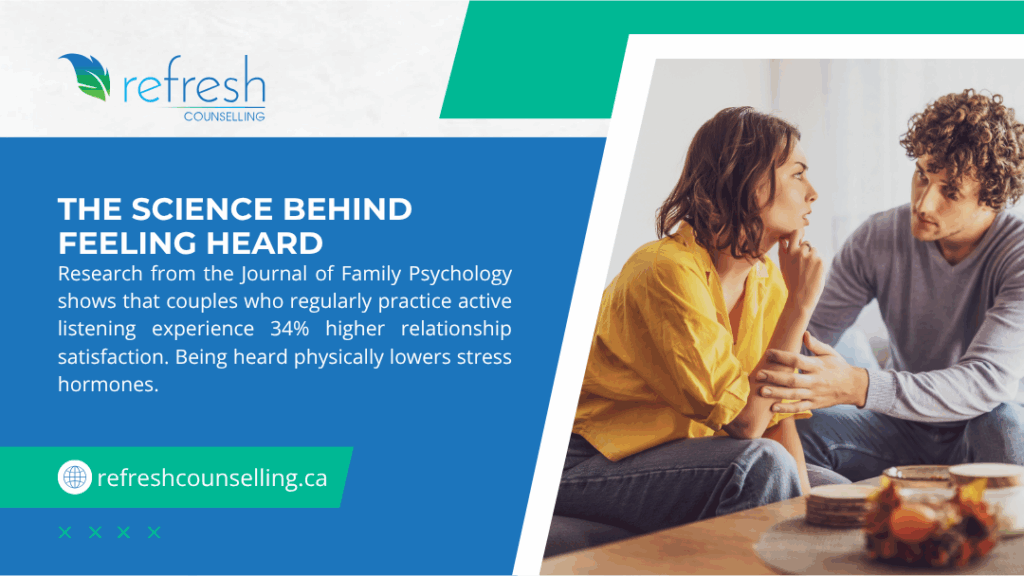
3. Instead of “You” Accusations, Use “I” Statements
The way in which you express your requirements dictates whether your partner hears your point or becomes defensive.
You can compare these two approaches:
- The way of accusation: “You never listen to me. You’re always distracted and you don’t care about my feelings.”
- The need-based way: “I feel disconnected when we don’t have focused time together. I need regular moments where we’re both fully present with each other.”
You can see the difference between the first and second situation, now here are more examples:
| Defensive Phrasing | Productive Phrasing |
| “You make me feel unimportant” | “I feel unimportant when plans change without discussion” |
| “You never prioritize me” | “I need to feel prioritized through quality time together” |
| “You don’t care about my feelings” | “I need emotional validation when I share difficult feelings” |
| “You’re too sensitive about everything” | “I need space to express concerns without immediate defensiveness” |
This communication style creates what we call “emotional validation between partners.” Your partner can hear your experience without feeling attacked, which makes them much more likely to respond with care.
As a psychologist, I’ve watched countless couples transform their dynamic simply by switching from blame to honest sharing.
4. Be Specific About What Would Help
The more specific you are about how to communicate your needs in a relationship, the easier it becomes for your partner to meet them.
Here are a few examples that show how being specific can help your partner understand what your needs are.
| Vague Request | Why It Doesn’t Work | Specific Alternative | Why It Helps |
| “I need more support.” | Too general. | “I feel loved when we hold hands or you kiss me goodbye. Can we do that more often?” | Shows exactly what support looks like. |
| “I need better communication.” | No clear action. | “Let’s spend 20 minutes after dinner talking with no phones.” | Sets a clear time and habit. |
| “I need you to help more with the house.” | Too broad. | “Can we clean the kitchen together after meals?” | Makes the request simple and doable. |
If you are struggling with how to rebuild trust in a relationship, being specific about your needs becomes even more important. You can read our article to learn more.
5. Practice Expressing Small Needs First
If you’ve spent years not speaking up, starting with your biggest relationship might feel overwhelming. Build your confidence by practicing with smaller, lower-stakes needs first.
Progressive practice looks like this:
| Stage | Type of Need | Example Request |
| 1. Easy | Logistical help | “Could you grab milk on your way home?” |
| 2. Medium | Preference sharing | “I’d really love to try that new restaurant this weekend” |
| 3. Deeper | Emotional connection | “I need more one-on-one time with just us talking” |
| 4. Core | Relationship patterns | “I need us to handle conflict differently because the silent treatment hurts me deeply” |
Each time you express a need and your partner responds positively, you build evidence that speaking up is safe. This creates what psychologists call “building emotional safety with your partner.”
6. Listen to Your Partner’s Needs Too
Communication and emotional well-being are like a “two-way street”.
After you have expressed your needs, allow your partner to do the same. There may be times when your needs are different, and that is where the growth of the relationship will take place.
It could be that you are the one wanting to go out with friends and your partner prefers to stay in couples’ activities. There is nothing wrong with either need, but it is up to you to reach a point that respects both.
Healthy compromise includes:
- Taking turns meeting each other’s different needs
- Finding creative solutions that partially satisfy both needs
- Being willing to stretch outside your comfort zone sometimes
- Respecting when certain needs are non-negotiable dealbreakers
From my experience as a psychologist, the couples who succeed aren’t the ones without conflicting needs. They’re the ones who navigate those conflicts with respect and creativity.
This back-and-forth creates mindful communication in love. You’re both tuning into what matters most to each person and working together to build a relationship that feels good for both of you.
If you’re dealing with patterns where one person’s needs always take priority, couples counseling can help you rebalance this dynamic.
7. Set Healthy Emotional Boundaries
Healthy emotional boundaries mean understanding what behavior you can accept and what crosses a line for you. These boundaries protect your mental clarity and relationship balance.
Some examples of healthy boundaries:
| Boundary Type | What It Protects | How to Communicate It |
| Emotional | Your feelings and self-worth | “I need conversations that don’t involve criticism of my character” |
| Time | Your energy and personal needs | “I need two evenings a week for my own activities” |
| Physical | Your comfort and safety | “I need physical affection to be mutual and welcomed, not demanded” |
| Communication | How you’re spoken to | “I need us to pause conversations that become disrespectful” |
Boundaries aren’t about controlling your partner. They’re about taking responsibility for your own wellbeing while staying in the relationship.
If setting boundaries brings intense guilt or if your partner consistently ignores them, individual therapy can help you understand why and what to do next.
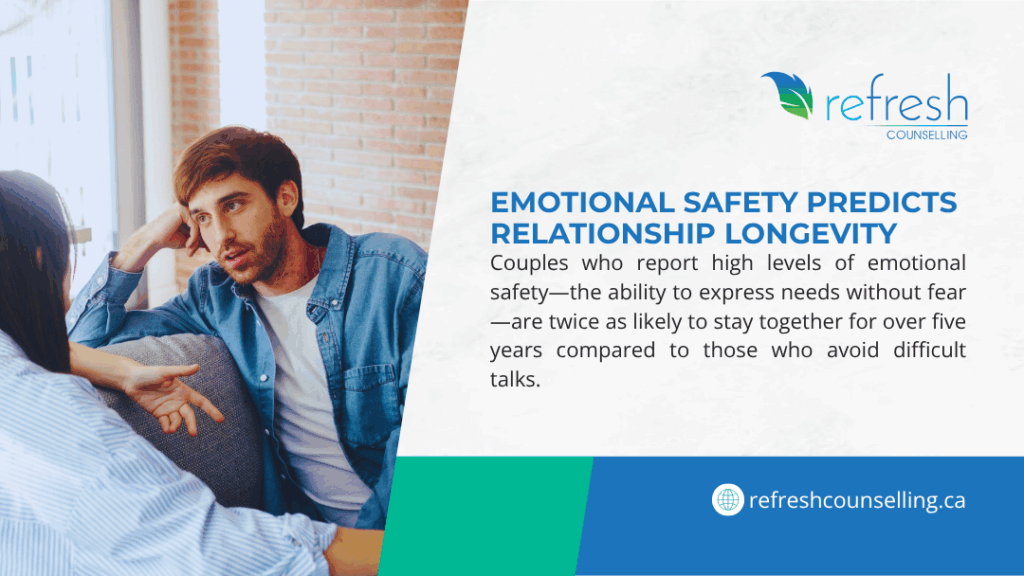
When Professional Support Makes the Difference
Sometimes the patterns run too deep for couples to untangle alone.
If you’ve tried expressing your needs but nothing changes, or if past trauma makes communication feel impossible, professional help provides tools you can’t develop on your own.
Signs that counselling could help:
- You’ve tried communicating needs but your partner dismisses or ignores them
- Past relationships or childhood experiences make expressing needs terrifying
- Conversations always escalate into destructive fights
- You don’t even know what your needs are anymore
- One or both partners struggle with anxiety that blocks honest communication
- You’re stuck in patterns where needs never get met
Our counseling services in Calgary have been the top choice for many couples who have developed stronger communication skills, rebuilt trust, and deepened emotional intimacy.
The therapists at Refresh Counselling are well aware of the fact that it is very difficult to communicate your needs in a relationship, especially when anxiety or previous trauma is involved.
Feel free to get in touch with our team today to find out how professional counseling can make you and your partner feel that you are really being heard and understood.